
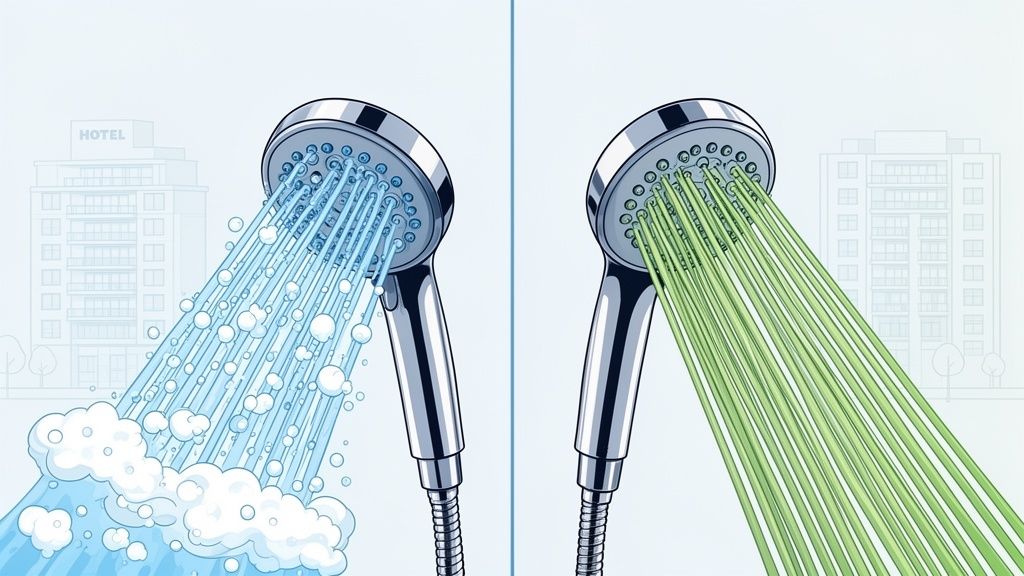
For any facility manager, keeping a tight rein on operational costs is job number one. High efficient shower heads used to be seen as just an eco-friendly perk. Not anymore. Now, they’re one of the smartest financial moves a commercial building can make.
By cutting down on water, these fixtures also dramatically reduce the energy needed to heat that water. That hits one of your biggest utility expenses right where it hurts.
Why Smart Facilities Are Switching To High Efficiency Shower Heads
In places like hotels, apartment buildings, gyms, and universities, showers are a constant, massive drain on the budget. Every single minute a shower is running, it’s not just water going down the drain—it’s money spent on heating that water.
Older fixtures, many of which still guzzle 2.5 gallons per minute (GPM) or more, are quietly bleeding your budget dry with every single use. Making the switch to high-efficiency models is a direct, easy-to-measure way to stop the bleeding.
Think of this as more than just swapping out some old hardware. It’s a business decision with a crystal-clear return on investment. The real magic is in the “two-for-one” savings: you slash both your water and your energy bills at the same time. For a big property with hundreds of showers, those savings stack up fast, often reaching tens of thousands of dollars a year.
More Than Just Savings
Beyond the immediate cash back in your operating budget, upgrading your shower heads brings some other major wins for property owners and facility managers. It’s a smart way to prepare your building for the future and make it more appealing today.
Here’s what else you get:
- Reduced Wear and Tear: Using less hot water means your boilers and water heaters aren’t working as hard. This can extend the life of that expensive equipment and cut down on maintenance calls.
- Higher Property Value: Modern, water-saving fixtures are a big plus for tenants and guests. It shows them the property is modern, well-run, and green-conscious.
- Staying Ahead of Regulations: More and more cities and corporations are rolling out tough environmental standards. An upgrade keeps you in compliance and helps you avoid future fines.
A high-efficiency retrofit is one of the fastest and most cost-effective ways to get serious utility savings. The payback is often less than a year, making it one of the best bangs for your buck in the entire conservation playbook.
Smart facilities are always looking for ways to reduce overall energy consumption, and shower heads are low-hanging fruit. Unlike a huge HVAC overhaul, a shower head project causes minimal disruption and delivers results you can count on. It’s a clear signal to everyone—from investors to tenants—that you’re serious about running an efficient and responsible building.
How Modern Shower Heads Save Water Without Losing Pressure
If you’re a facility manager thinking about a water-saving retrofit, you probably have one major concern: guest or tenant satisfaction. It’s the number one question we hear. How can you possibly use less water without getting a flood of complaints about weak, unsatisfying showers?
That’s a totally valid fear, but it’s based on outdated technology. Today’s high efficient shower heads are engineered specifically to solve this problem, delivering a powerful-feeling spray while dramatically cutting down on water use.
The secret is in how these modern heads manipulate the water stream to make it feel much stronger than its flow rate would suggest. Understanding the two main technologies is the key to picking the right fixture for your building.
Aerating Shower Heads: Full Feel, Less Water
Think of an aerating shower head like the steam wand on a fancy cappuccino machine. It doesn’t just let water pass through; it pulls in air and infuses the stream with millions of tiny bubbles.
This simple process has a huge impact on the shower experience:
- It creates volume: All that air bulks up the water stream, so the spray feels much fuller and more substantial when it hits your skin.
- It increases perceived pressure: The mix of air and water creates a more vigorous, tingling sensation that most people associate with great pressure.
- It maintains temperature: The air helps the water hold onto its heat, delivering a warm and comfortable shower from start to finish.
Because the stream feels so robust, guests and tenants almost never realize the fixture is using way less water. This makes aerating shower heads a perfect fit for hotels, resorts, and any hospitality setting where guest experience is everything. They deliver that luxury feel while quietly saving you a bundle on water and energy.
Laminar Flow Shower Heads: Clean Streams, Less Steam
Where an aerating head infuses water with air, a laminar-flow shower head does the opposite. It works more like a bundle of tiny, smooth straws, organizing the water into dozens of individual, solid streams.
This technology creates a drenching sensation with distinct columns of water. Since no air gets mixed in, the water streams are clear and produce a lot less steam and humidity than an aerating head.
This might seem like a small detail, but it has major benefits in certain commercial spaces. Laminar-flow heads are the go-to choice for:
- Hospitals and Healthcare Facilities: Less steam means lower ambient humidity. This is a game-changer for controlling the growth of mold and mildew in bathrooms, which is critical for maintaining a hygienic environment.
- Gyms and Fitness Centers: High-traffic shower areas can get incredibly humid, fast. By cutting down on steam, laminar-flow heads reduce the strain on your HVAC system, which no longer has to work overtime to dehumidify the air.
- Coastal or Humid Climates: In places where humidity is already a battle, these heads stop showers from making the problem worse, leading to better indoor air quality and comfort.
The Technology That Guarantees Performance
Beyond the spray type, there’s another piece of brilliant engineering that ensures modern high efficient shower heads always perform well: pressure compensation.
Think about a large apartment building or hotel. The water pressure on the first floor can be booming, while the top floor gets a disappointing trickle. This is where pressure compensation saves the day.
These clever devices have a flexible rubber o-ring or diaphragm inside. When water pressure is high, the ring constricts to limit the flow. When pressure is low, it expands to let more water through. This mechanism automatically regulates the flow, guaranteeing a consistent, strong spray no matter where you are in the building. To really dig into this feature, you can learn more about how a pressure compensating showerhead or aerator works in our detailed guide. It’s the unsung hero that ensures every single shower, from the ground floor to the penthouse, feels just right.
Calculating The Real ROI Of Your Shower Head Retrofit
While the performance benefits of new, efficient fixtures are great, the final decision to upgrade usually boils down to dollars and cents. For facility managers and property owners, the return on investment (ROI) is everything. Calculating this figure gives you the hard data to justify a retrofit project and prove its value.
The real financial magic of a high efficient shower head is its “dual savings” effect. Every gallon of hot water you don’t use does more than just lower your water bill—it also slashes your energy costs, since your water heaters aren’t working as hard. It’s this two-for-one punch that makes a shower head retrofit one of the fastest-paying conservation projects out there.
To figure out your specific ROI, you need a formula that plugs in your property’s unique numbers. This isn’t just a guess; it’s a solid business forecast.
The Core Savings Formula
The basic formula for figuring out your annual savings is actually pretty simple. It just combines what you’re using now with the savings you’ll get from a new, more efficient fixture.
Here are the key inputs you’ll need to round up:
- Number of Showers: The total number of shower units across your property.
- Average Use Time: The estimated minutes per shower. An 8-minute average is a good industry benchmark if you don’t have hard data.
- Annual Use Days: How many days a year each shower is used. For an apartment complex, this might be 330 days. For a hotel, it’s your average occupancy rate multiplied by 365.
- Flow Rate Difference: The GPM difference between your old heads and the new ones (e.g., 2.5 GPM – 1.5 GPM = 1 GPM saved).
- Local Utility Costs: Your exact cost per gallon of water/sewer and your cost per kWh (for electric) or therm (for gas).
Once you have this info, you can project your savings with real confidence. If you want a more detailed guide on getting started, our post on how to measure your shower water usage can help you nail down an accurate baseline.
Real-World Example A 150-Unit Apartment Complex
Let’s make this real. Imagine you manage a 150-unit apartment building. Your showers are running at an outdated 2.5 GPM, and you’re thinking about swapping them for 1.5 GPM models.
Here are the numbers for our scenario:
- Units: 150
- Showers Per Day Per Unit: 1.5
- Average Shower Length: 8 minutes
- Occupancy: 330 days per year
- Water/Sewer Cost: $0.015 per gallon
- Electric Heating Cost: $0.12 per kWh
First, let’s figure out the water saved per shower: (2.5 GPM – 1.5 GPM) x 8 minutes = 8 gallons saved per shower.
Next, the total annual water savings: 150 units x 1.5 showers/day x 8 gallons/shower x 330 days = 594,000 gallons saved per year. At $0.015 per gallon, that’s $8,910 in annual water savings.
The energy savings are just as impressive. It takes roughly 1 kWh to heat 5 gallons of water. This means your energy savings are about 118,800 kWh, which adds up to $14,256 in annual energy savings.
Total Projected Annual Savings: $23,166
This simple retrofit pays for itself incredibly fast—often in under six months—and then keeps putting money back in your pocket year after year. Understanding how these upgrades add value is crucial. For a broader look at how smart improvements can pay off, you can find great insights on how to boost your bathroom remodel return on investment. It proves that a shower head project isn’t an expense, but a high-yield investment.
Projected Annual Savings Per Upgraded Shower Head
To give you a clearer picture, this table shows the kind of annual savings you could see by upgrading just one shower head. These numbers are based on replacing a standard 2.5 GPM shower head.
Assumptions: 8-minute average shower, 200 days of use per year, electric water heating at $0.12/kWh, and water/sewer costs at $0.015/gallon.
| New Shower Head GPM | Annual Water Savings | Annual Energy Savings | Total Estimated Annual Cost Savings |
|---|---|---|---|
| 1.75 GPM | 1,200 gallons | $28.80 | $46.80 |
| 1.50 GPM | 1,600 gallons | $38.40 | $62.40 |
| 1.25 GPM | 2,000 gallons | $48.00 | $78.00 |
| 1.00 GPM | 2,400 gallons | $57.60 | $93.60 |
As you can see, even a single upgraded fixture delivers meaningful savings. Now, multiply that by every shower in your facility, and the business case becomes undeniable.
How To Select The Right Commercial Shower Head
Choosing a shower head for a commercial property is a completely different ballgame than picking one out for home use. A homeowner might get caught up in aesthetics, but for a facility manager, the decision has to be rooted in durability, security, and the long-term cost of keeping it running.
For any business, a shower head isn’t just a fixture; it’s an asset that needs to perform day in and day out under heavy, constant use. The GPM rating is a great place to start, but it’s just one piece of the puzzle. The real story is in the materials, tamper-resistance, and how much time you’ll spend on maintenance. These are the factors that separate a smart investment from a future headache.
Durability First: Solid Brass Construction
In high-turnover places like university dorms, military barracks, or fitness centers, your average plastic shower head just won’t cut it. They simply don’t last. Constant use, accidental drops, and even harsh cleaning chemicals lead to cracks, leaks, and a cycle of frequent replacement.
This is exactly why solid brass construction is the gold standard for commercial jobs. Brass fixtures have a much longer service life and can easily stand up to the daily grind of a public facility. Yes, the upfront cost is higher than plastic, but the total cost of ownership is far lower when you stop and think about fewer replacement orders and maintenance calls.
For properties that need both longevity and a more premium feel, like luxury hotels or high-end apartments, our collection of durable all-metal shower heads delivers that perfect blend of tough performance and lasting quality.
For a commercial property, a shower head’s true cost isn’t its purchase price—it’s the price plus the cost of every replacement and maintenance call over its lifetime. Investing in durability from the start is the most financially sound strategy.
Security Matters: Tamper-Resistant Designs
In any facility open to the public or in multi-tenant housing, theft and vandalism are very real concerns. A standard shower head can be unscrewed and stolen in seconds, leaving you with replacement costs and a non-functional unit. This is where tamper-resistant models are an absolute must.
These specialized high-efficiency shower heads are built from the ground up with security in mind. They usually feature:
- A fixed design that can’t be taken apart or removed without special tools.
- A continuous, one-piece body which gets rid of weak points and discourages tampering.
- Recessed or specialized fasteners that stop casual theft in its tracks.
By installing tamper-proof fixtures, you’re protecting your investment. You’re also making sure the water and energy savings you paid for don’t literally walk out the door. These are especially critical for government buildings, schools, and public recreation centers. Take a look at our range of tamper-proof shower solutions designed for maximum security.
Performance Guaranteed: The EPA WaterSense Label
Let’s be honest: many early low-flow shower heads earned a terrible reputation for delivering a weak, unsatisfying trickle. This has made plenty of facility managers wary of making the switch. But the EPA’s WaterSense certification was created specifically to solve this exact problem and acts as your guarantee of solid performance.
A shower head can’t get the WaterSense label just by using less water. To get certified, a fixture must not only have a flow rate of 2.0 GPM or less but also pass a whole battery of tough, independent tests for spray force and coverage. This process makes sure the shower experience meets or even beats what you’d get from older, less efficient models.
When you choose a WaterSense-certified product, you’re picking a fixture that’s proven to deliver both savings and satisfaction. It takes the guesswork out of retrofits and eliminates the risk of complaints from tenants or guests. That seal of approval confirms you’re investing in proven technology, not just crossing your fingers and hoping for the best.
A Practical Guide To Installation And Maintenance
Your work isn’t done just because the new high efficient shower heads have arrived. The savings you’ve so carefully calculated only become real with proper installation and a consistent maintenance plan. This is where your facilities team steps in to protect the investment and guarantee long-term performance.
A rushed installation can create immediate leaks, while skipping maintenance lets mineral buildup slowly choke off your savings. Here’s how your team can get it right from day one and keep your new fixtures working at peak efficiency for years.
Your Leak-Proof Installation Checklist
Proper installation is your first and best defense against water waste. Swapping a shower head might seem like a simple job, but a single slow drip from a bad connection can waste hundreds of gallons a year, completely undermining the upgrade.
Arm your maintenance team with this simple process for every fixture:
- Remove the Old Fixture: Use a wrench to turn the old head counter-clockwise. A simple trick is to wrap the wrench’s jaw in a cloth to avoid scratching the shower arm’s finish.
- Clean the Threads: Get in there and thoroughly clean the threads on the shower arm. You need to remove all the old plumber’s tape, mineral gunk, and any other residue. A truly clean surface is what you need for a perfect seal.
- Apply New Thread Seal Tape: Don’t even think about skipping this step. Wrap high-quality thread seal tape around the threads 3-4 times in a clockwise direction. Wrapping it clockwise is key—it ensures the tape tightens as you screw on the new head instead of bunching up or unraveling.
- Install the New Shower Head: Start by hand-tightening the new high-efficiency head, turning it clockwise. Once it’s snug, use the wrench for a final, gentle quarter-turn. Do not over-tighten! This is a classic mistake that can crack the fixture’s base or strip the shower arm threads.
- Check for Leaks: Turn the water on and watch the connection point closely for any drips. If you see a leak, you’ll need to take the head off, re-tape the threads, and install it again.
The single most common installation error is failing to properly clean and tape the shower arm threads. This simple mistake creates “silent leaks” that can completely cancel out the water and energy savings of your new high efficient shower heads.
Creating A Simple Preventative Maintenance Plan
Once they’re installed, your new shower heads have one main enemy: mineral scaling. Over time, hard water deposits like calcium and magnesium will clog the nozzles, mess up the spray pattern, and restrict flow. This is what quietly kills a fixture’s efficiency.
A proactive plan is always better than just reacting to tenant or guest complaints.
Cleaning Frequency:
- Hard Water Areas: Quarterly (every 3 months)
- Soft Water Areas: Bi-annually (every 6 months)
The cleaning process itself is straightforward. And if you want to get a better handle on water flow across your property, our guide on how a shower head regulator can help is a great resource for your overall conservation strategy.
The Right Way to Clean:
- Approved Cleaning Agent: A simple solution of 50% white vinegar and 50% water is the safest and most effective cleaner you can use.
- Avoid Harsh Chemicals: Never use abrasive cleaners, bleach, or aggressive acids. These will eat away at the fixture’s finish and destroy internal components like rubber seals and the pressure-compensating parts that make a high-efficiency model work.
- Soaking Method: Just unscrew the shower head and let it soak in the vinegar solution for at least 30-60 minutes. If you’ve got some really stubborn buildup, it’s fine to let it soak a bit longer.
- Rinse and Reinstall: After the soak, use a soft brush to gently scrub away any gunk that’s left. Rinse the head completely with clean water before reinstalling it, following the same steps from the installation checklist.
Finding Rebates to Maximize Your Project’s Value
Switching to high-efficiency shower heads will start saving you money on water and energy from day one. But you can slice that payback period down even more by tapping into outside funding. Not looking for these programs is like leaving cash on the table.
Many local utilities offer big-time rebates for commercial properties that invest in water and energy efficiency. These programs are there for a reason—water and energy providers want to reward businesses for cutting demand on the local supply. A little bit of searching can turn your project from a necessary expense into a smart, partially subsidized investment.
Where to Find Commercial Rebate Programs
Finding these rebates takes a bit of targeted searching, and they change a lot depending on where you are. Commercial programs are usually a whole different ballgame than the residential ones you might see advertised.
Here’s where you should start your hunt:
- Your Local Water Utility: This is your first stop. Most water districts have conservation departments with programs built specifically for commercial customers. Search their websites for terms like “commercial rebates,” “business incentives,” or “water conservation for facilities.”
- Your Electric or Gas Provider: Don’t forget, efficient shower heads mean using less hot water, and that means saving energy. Your power company is another prime source for rebates because they reward you for cutting down on the kWh or therms needed to heat water.
- State and Municipal Programs: Sometimes, bigger government programs offer grants or tax credits for green building upgrades. The best part? You can often stack these on top of utility rebates for the biggest possible financial win.
When you reach out to these providers, have your project details ready to go. They’ll need to know the number of fixtures you’re replacing, the GPM of your old shower heads, and the GPM of the new high-efficiency models. This is the key data they use to figure out your rebate amount.
Getting Compliant and Future-Proofing Your Facility
Beyond the immediate cash back, upgrading your shower heads is a smart move to keep your property in line with changing regulations. The federal Energy Policy Act of 1992 was the first to cap shower head flow rates at 2.5 GPM, but a lot has changed since then.
Many states and even cities have gotten much stricter. Places like California, Colorado, and Washington have dropped the limit to 2.0 GPM or even 1.8 GPM for new projects.
By choosing WaterSense-certified fixtures (which are all 2.0 GPM or less), you’re not just qualifying for the best rebates—you’re making sure your facility is up to modern code. For businesses that need fixtures with proven durability and guaranteed compliance, our selection of WaterSense-certified commercial shower heads is the perfect place to start. Think of it less as a simple cost-cutting project and more as a critical investment in protecting your property from future regulations.
Frequently Asked Questions From Facility Managers
If you’re a facility manager or purchasing agent, the idea of switching to high efficient shower heads probably brings up a few big questions. You’re thinking about performance, durability, and most of all, keeping your tenants happy.
We get it. In a commercial setting, every fixture has to pull its weight and deliver on its promise of saving you money. Let’s get right to the most common questions we hear from clients just like you.
Will Tenants Or Guests Complain About Low Water Pressure?
This is the number one concern we run into, and it’s usually based on experiences with older, lackluster “low-flow” products. The good news is, today’s high-efficiency shower heads are in a completely different league.
They are specifically engineered with advanced tech like aeration and pressure compensation. These designs create the feeling of a strong, satisfying shower, even while using significantly less water.
For properties where the guest experience is everything—like hotels or luxury apartments—we always suggest piloting a few different models. This lets you get direct feedback before committing to a building-wide rollout and ensures you land on a shower head that meets your tenants’ expectations.
How Do I Prove A Shower Head Is Truly High Efficiency?
Don’t just take a manufacturer’s word for it. The best way to know you’re getting a proven performer is to look for the EPA WaterSense label.
To earn this seal, a shower head must have a flow rate of 2.0 GPM or less and pass a series of tough, independent third-party tests for spray force and coverage.
The WaterSense label is your guarantee that the product actually works as advertised. All WaterSense-certified shower heads on ConservationMart.com meet these strict federal standards, so you can purchase with confidence.
Are High-Efficiency Shower Heads Harder To Maintain?
Nope. In fact, their maintenance is exactly the same as any standard shower head. We often find that installing brand-new, clog-free heads actually reduces your immediate maintenance calls, since you’re getting rid of old, mineral-crusted fixtures.
The real key to long-term performance is just a simple, regular cleaning routine, especially if you’re in an area with hard water. A quick quarterly check and a soak in a mild vinegar solution is usually all it takes to keep them running like new for years.
At Conservation Mart, LLC, we specialize in durable, high-performance conservation products built for commercial and institutional use. Take a look at our complete catalog of commercial-grade high efficient shower heads and find the perfect fit for your property.