
An aerating shower head is a simple fixture with a powerful one-two punch: it mixes air with water to create a full, satisfying spray while using significantly less water than a standard model. It’s a straightforward technology that allows businesses to slash both their water consumption and the energy costs tied to heating that water, often delivering a surprisingly fast return on investment. For facility managers and procurement specialists, this makes it a critical tool for operational efficiency.
View Our Low-Flow Shower Heads Here
Why Businesses Are Switching to Aerating Shower Heads
For any business that manages properties with multiple shower facilities—think hotels, gyms, apartment complexes, or hospitals—utility costs are a major and unavoidable operational expense. In that context, upgrading to aerating shower heads stops being just an eco-friendly choice and becomes a critical financial strategy. Think of these fixtures as a direct investment in your operational efficiency and, ultimately, your bottom line.

The concept behind them is simple but incredibly effective. By pulling air into the water stream, an aerating shower head maintains the high-pressure feel that guests and tenants expect. But here’s the magic: it does this while cutting the gallons per minute (GPM) flow rate, sometimes by 40% or more. That immediate drop in water use translates directly into lower utility bills.
The Two-Fold Financial Benefit
The savings generated by an aerating shower head come from two distinct sources, which is what makes it such a compelling upgrade for any facility manager or procurement specialist. The first benefit is obvious, but the second one is often where the real money is.
- Reduced Water Costs: Less water flowing through each fixture means a smaller water bill, plain and simple. When you scale that across dozens or even hundreds of units in a commercial property, it adds up to thousands of dollars in annual savings.
- Lower Energy Expenses: A significant portion of a commercial building’s energy budget goes toward heating water. By using less hot water for every single shower, your facility’s water heaters don’t have to work as hard, leading to a measurable drop in your gas or electric bills.
This double-dip on savings is what makes the business case for these fixtures so strong. It’s an upgrade that pays for itself quickly, often within a single year.
An aerating shower head attacks two of the largest variable expenses in facility management: water and energy. This isn’t just a green initiative; it’s a powerful tool for improving net operating income and boosting asset value.
On top of that, adopting water-efficient technology aligns perfectly with modern corporate sustainability goals. Showing a real commitment to conservation can elevate your brand’s reputation with clients, tenants, and investors who value environmental responsibility. Exploring the wide range of commercial-grade aerating shower heads on Conservation Mart is the first step toward unlocking these substantial financial and reputational benefits.
How Aeration Delivers Savings Without Sacrificing Performance
For many facility managers, the term “low-flow” can be a red flag. It often brings to mind weak performance and a flood of complaints from tenants or guests. The primary concern is that saving water automatically means a poor shower experience. But that’s an outdated myth, and modern aerating shower heads completely dismantle it with clever engineering.
The science behind it is actually quite simple. Inside the fixture, a small screen with tiny holes acts as an aerator. As water passes through this screen, it pulls in the surrounding air and mixes it directly into the stream. This process infuses thousands of microscopic air bubbles into the water droplets, which makes the spray feel much fuller and more powerful. The result? A shower experience that satisfies users, even though it’s using far less water.
A Better User Experience
This is a night-and-day difference from older, non-aerating low-flow heads. Those early models simply restricted the water flow, which usually led to a thin, weak, and sometimes “stinging” spray that was terrible at rinsing off soap.
An aerating shower head fixes this by creating larger, softer water droplets that are full of air. This not only feels more luxurious but also helps the water retain its heat longer on its way from the fixture to the user. That means a consistently warm shower, which is a significant factor for user satisfaction in places like hotels, gyms, and multi-family housing.
The secret to aeration isn’t about using less water; it’s about making every drop work harder. By bulking up the spray with air, it creates a premium shower experience that meets modern expectations while cutting utility costs.
The Two-Fold Savings Unlocked by Aeration
For any commercial property, the benefits are significant and impact two of the biggest line items in an operational budget. The savings come from two different angles, delivering a powerful one-two punch to your bottom line.
1. Direct Water Consumption Savings The most obvious win is the immediate drop in water usage. An old, standard shower head can easily use 2.5 gallons per minute (GPM) or even more. Switching to a high-efficiency aerating model can bring that down to 1.5 GPM or less—that’s a 40% reduction, or more, from a single fixture. When you scale that across hundreds of units running every day, you’re looking at tens of thousands of gallons of water saved each year and a direct, significant drop in your water bills. The GPM rating is the key metric here, a topic you can dive into by understanding how shower GPM impacts your facility.
2. Indirect Energy Savings Just as important are the energy savings you don’t always see. A huge chunk of any commercial building’s energy bill goes to heating water. Every gallon of hot water you don’t use is also a unit of energy—gas or electric—that you no longer have to pay to heat.
In high-use facilities like hotels or fitness centers where showers are going almost constantly, the energy saved by heating less water can often match or even exceed the savings from the water itself. This powerful combination of water and energy efficiency is what makes upgrading to an aerating shower head one of the smartest, most cost-effective retrofits a business can make. It’s an investment that pays for itself, and fast.
Crunching the Numbers: What’s the Real ROI?
It’s one thing to talk about benefits, but for procurement managers and facility operators, the conversation always comes down to the bottom line. You need to see the hard numbers. The good news is that the return on investment for upgrading to aerating shower heads isn’t just a vague promise—it’s something you can calculate with simple, clear formulas.
This lets you build a rock-solid business case, showing exactly how and when the initial investment pays for itself through lower water and energy bills. Let’s break down how to calculate those savings.
How to Calculate Your Water Savings
The most direct saving comes from simply using less water. To figure this out, you just need to compare the flow rate of your current shower heads to the new aerating models. Most older, standard fixtures run at 2.5 gallons per minute (GPM), while a typical aerating shower head uses a much lower 1.5 GPM.
Here’s the formula to calculate how many gallons you’ll save each year for a single shower head:
(Old GPM – New GPM) x Average Shower Time (minutes) x Showers Per Day x 365 Days = Total Gallons Saved Annually
Let’s run the numbers for a single hotel room or apartment unit, assuming one 8-minute shower per day:
- (2.5 GPM – 1.5 GPM) x 8 minutes x 1 shower/day x 365 days = 2,920 gallons saved per year.
Now, turn those gallons into dollars. Just multiply the gallons saved by your local water and sewer rate. If your combined rate is, say, $0.015 per gallon, the annual savings for just one shower head comes out to $43.80. Imagine that scaled across 100, 200, or 500 units. The financial impact adds up fast.
For the most accurate projections, it’s always best to start by measuring your current shower water usage to get a precise baseline.
Don’t Forget the Energy Savings—It’s a Big Deal
Here’s where the savings really get supercharged. Every gallon of hot water you don’t use is a gallon you don’t have to pay to heat. This is often the biggest piece of the financial puzzle and where aerating shower heads deliver a powerful one-two punch to your utility costs.
To calculate this, you’ll need to know two things:
- Your water heater type (electric or natural gas)
- Your local utility rates for electricity (per kWh) or natural gas (per therm)
The math here is a bit more involved, but it all comes down to the energy required to heat the water you’ve saved. Facilities with electric water heaters often see the most dramatic savings. Using our earlier example of saving 2,920 gallons a year, heating that much water with an electric system could take over 400 kWh of power. At an average rate of $0.15 per kWh, that’s another $60 in annual savings per fixture. The savings are significant with natural gas, too.
This chart gives you a quick visual of how aeration pulls this off—delivering a better shower experience while slashing water and energy use.
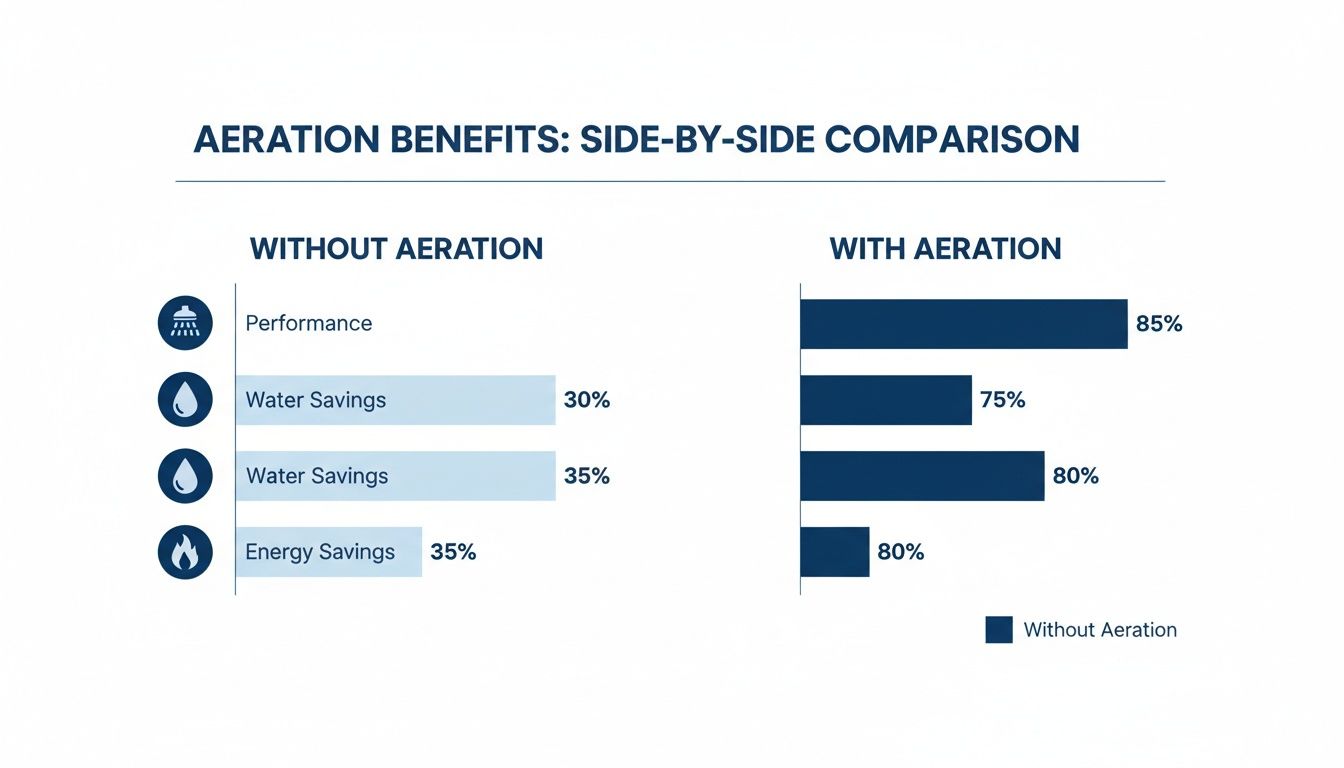
As the graphic shows, the technology that creates that full, satisfying spray is the very same thing that drives these huge reductions. Industry data consistently shows that swapping old fixtures for 1.5–2.0 GPM models can cut shower water use by 20%–40% per shower, a number that flows directly to your bottom line.
Projecting Your Total Return on Investment
To make it easy to see the potential for your entire property, the table below breaks down the annual savings you can expect from swapping just one standard shower head for a high-efficiency 1.5 GPM aerating model.
Projected Annual Savings Per Aerating Shower Head (1.5 GPM)
This table illustrates the potential annual water and energy cost savings achieved by replacing one standard 2.5 GPM shower head with a 1.5 GPM aerating model, based on average usage metrics.
| Metric | Calculation Basis | Annual Savings |
|---|---|---|
| Water Savings | Based on one 8-minute shower per day and a utility rate of $0.015/gallon. | $43.80 |
| Energy Savings | Based on heating 2,920 gallons with an electric water heater at $0.15/kWh. | $61.55 |
| Total Annual Savings | Combined water and energy savings from a single shower head upgrade. | $105.35 |
Now, just multiply that “Total Annual Savings” figure by the number of showers in your facility to get a clear estimate of the project’s total financial impact.
With high-quality commercial aerating shower heads often costing between $10 and $20, the payback period is typically just a few months. That makes this one of the quickest and most cost-effective capital improvements you can make.
Selecting the Right Shower Head for Commercial Use
When outfitting a commercial property, picking a shower head isn’t as simple as selecting a low-flow model off the shelf. Think about the constant, heavy use they’ll receive in places like hotels, gyms, or apartment complexes. These fixtures have to stand up to significant wear and tear. That means durability, security, and consistent performance are just as crucial as water savings. Making the right choice from the outset saves you from the headache of constant replacements and ensures your investment actually pays off.
Not every aerating shower head is cut out for the commercial world. A standard plastic model might work fine for residential use, but a busy facility needs hardware that’s built for the long haul and public use. Let’s walk through the key factors to consider so you can find the right fit for your property.
Durability First and Foremost
The first thing to check on any commercial fixture is its material composition. Plastic shower heads might be cheaper upfront, but they are prone to cracking and thread stripping over time. That leads to leaks and a cycle of replacements, making them a poor long-term investment for any business.
Instead, always look for models made from chrome-plated solid brass. This material is tough. It has superior strength and won’t corrode, meaning it can handle the daily grind for years without breaking down. Solid brass construction is the gold standard for a commercial-grade fixture and is the key to making your upgrade last.
Tamper-Proof Designs for Public Spaces
In any property open to the public or tenants—think fitness centers, dorms, or multi-family housing—tampering and theft are real issues. A standard shower head that can be easily unscrewed will quickly disappear, taking your water and energy savings with it.
To prevent this, you need tamper-proof aerating shower heads. These are specifically designed with features to stop unauthorized removal:
- They often have a solid, one-piece construction, which eliminates weak spots.
- The spray patterns are fixed, so users can’t adjust or break them.
- They require specialized installation keys to mount and remove, making them nearly impossible to take off without the right tool.
Opting for a tamper-proof design ensures your investment stays on the wall, where it belongs.
The right commercial aerating shower head is a set-and-forget asset. It should be durable enough to withstand constant use and secure enough to prevent tampering, protecting your ROI from both wear and theft.
The Importance of EPA WaterSense Certification
As you’re comparing options, keep an eye out for the EPA WaterSense label. This isn’t just a marketing sticker; it’s a guarantee. It means the shower head has been independently tested and meets strict government standards for both water efficiency and performance. A WaterSense-certified aerating shower head is proven to deliver a satisfying shower while using 20% less water than standard models.
This certification is also a big deal for properties aiming for green building credentials like LEED (Leadership in Energy and Environmental Design), since it provides verified proof of resource conservation. You can see the influence of programs like WaterSense everywhere. Federal and state efficiency standards have pushed manufacturers to innovate, and market reports often point to these regulations as a major reason for the boom in water-efficient fixture sales.
Matching the Fixture to Your System
Finally, consider the specific needs of your plumbing and the people who will be using it. While a fixed spray aerating shower head is the toughest and most common pick for commercial jobs, there are other options. For instance, if you’re outfitting a facility that needs to accommodate guests with accessibility needs, a high-quality handheld aerating model might be the better choice. To help you sort through these choices, our detailed showerhead reviews can help find the best fit for different applications.
By thinking through the materials, security features, certifications, and spray options, you can pick an aerating shower head that not only slashes your utility bills but also stands up to the demands of a commercial environment for years to come.
Installation and Maintenance Best Practices
You can’t just install a new set of aerating shower heads and expect the savings to roll in forever. To truly maximize your return on this investment, you must get two things right: a proper installation from day one, and a consistent maintenance schedule. For facility managers and maintenance teams, this is non-negotiable.
A flawless install prevents annoying leaks and complaints right out of the gate. But it’s the routine upkeep that ensures those fixtures keep delivering the water and energy savings you expect for their entire lifespan. Following these best practices will protect your investment and guarantee the long-term performance that justified the upgrade in the first place.

A Step-By-Step Installation Guide for Commercial Properties
A rushed or sloppy installation is a recipe for leaks, damaged threads, and callbacks that waste your team’s time. Ensure your maintenance staff follows a careful, methodical process every single time.
- Gather the Right Tools: Before anyone touches a shower arm, make sure they have an adjustable wrench, soft cloths to avoid scratching the new chrome finish, and good-quality PTFE thread seal tape.
- Remove the Old Fixture: Use the wrench to turn the old shower head counter-clockwise. Remind your team to be gentle—you don’t want to strain the pipe hidden inside the wall.
- Clean the Shower Arm Threads: This is a crucial step. Once the old head is off, use a cloth or a small wire brush to get the threads on the shower arm completely clean. Scrape off any old tape, gunk, or mineral deposits.
- Apply New Thread Seal Tape: Wrap the clean threads with 3 to 4 layers of PTFE tape, making sure to wrap in a clockwise direction. This ensures the tape tightens as you screw on the new head, creating a perfect seal.
- Install the New Aerating Shower Head: Thread the new fixture onto the arm by hand first, turning it clockwise. Hand-tightening prevents cross-threading, a common mistake that can permanently ruin the fixture.
- Final Tightening: Place a soft cloth over the base of the new shower head to protect it, then use the wrench to give it a final quarter-turn. Do not over-tighten. It’s easy to crack the fitting or damage the internal washer by using too much force.
- Check for Leaks: Turn on the water and watch the connection point closely for any drips. If you spot a small leak, a tiny bit more tightening might do the trick.
Creating an Effective Long-Term Maintenance Schedule
The number one enemy of an aerating shower head’s performance is mineral buildup, especially if your properties have hard water. Limescale will clog the tiny holes in the aerator, disrupting the spray pattern and completely wiping out your water savings.
A simple maintenance schedule stops these problems before they can start.
Proactive maintenance isn’t just another task on the list; it’s an insurance policy for your ROI. A clogged aerator can easily turn a 1.5 GPM water-saver back into an inefficient nozzle that wastes both water and the energy used to heat it.
Put this simple checklist into action to keep every fixture working like new:
- Monthly Visual Check: During routine unit cleanings, have staff take a quick look at the shower spray. If the pattern is uneven or water is shooting out at odd angles, that’s the first sign of a clog.
- Quarterly Deep Clean: Once every quarter, unscrew the shower heads and let them soak overnight in a 50/50 mix of white vinegar and water. This simple trick dissolves mineral deposits without needing any harsh chemicals.
- Rinse and Reinstall: The next morning, use a small brush (an old toothbrush is perfect for this) to gently scrub any leftover gunk from the nozzle holes. Give the fixture a good rinse with clean water before putting it back on.
By making this straightforward installation and maintenance process a standard procedure, you ensure every single shower head performs as promised, protecting your bottom line for years to come.
The Future of Commercial Water Conservation
Choosing to upgrade your facility’s fixtures to an aerating shower head is more than just swapping out old hardware. It’s a strategic decision that puts your business ahead of the curve in modern building management. This technology isn’t just a passing trend; it’s a fundamental shift driven by powerful market forces that reward efficiency and environmental responsibility.
Looking at these bigger trends gives you the final piece of the puzzle, confirming that your investment is sound, smart, and built to last. The entire commercial fixture market is growing, which is a clear sign that this is a permanent change in industry standards. This boom is fueled by a perfect storm of rising utility costs, tougher environmental regulations, and growing demand from tenants and investors for genuinely sustainable properties.
Facilities that make the move to water-saving technology now are positioning themselves as leaders, not playing catch-up later.
Market Momentum and Projections
This shift toward water-efficient solutions is real, and it’s picking up speed. Market analysis shows that innovations like aeration are a huge part of this growth.
For example, the global shower heads market was valued at $8.56 billion in 2024 and is expected to explode to $21.4 billion by 2035. That’s a growth rate of 8.69% every single year. This growth is directly tied to the demand for products that deliver both a great experience and real savings. You can dig into the full analysis of shower head market growth drivers and forecasts on Spherical Insights.
This data isn’t just noise; it confirms that high-efficiency fixtures are part of the long-term evolution of property management.
Investing in aerating technology today isn’t just about cutting next quarter’s utility bill. It’s about future-proofing your assets against rising costs and new regulations, giving you a competitive edge for the next decade.
By making this upgrade, your business sends a clear message. It shows a forward-thinking commitment to both financial health and corporate responsibility. An aerating shower head is a small part that makes a big statement, proving your investment is a strategic move that delivers immediate ROI and value that lasts. It positions your property as modern, efficient, and responsible—exactly what today’s market demands.
Answers for Facility Managers
When you’re evaluating a major upgrade across dozens or hundreds of units, you need to be confident you’re making the right call. We understand. Here are the most common questions we hear from facility managers, with straight answers to help you make your decision.
Will An Aerating Shower Head Work With Our Building’s Low Water Pressure?
This is probably the number one concern we hear, and it’s a critical one. The good news is that most modern aerating shower heads are engineered to perform very well across a wide range of pressures.
That said, if your building has exceptionally low pressure (think below 40 PSI), you’ll want to be selective. In that case, you should look for a model specifically designed for low-pressure systems. These heads are built to create a strong, satisfying spray even when there isn’t much force behind the water. Always check the product specifications for the minimum required PSI or contact our team to ensure you’re getting a compatible model.
How Do We Prevent Theft Or Tampering In A Commercial Setting?
In places like gyms, hotels, or dorms, fixtures can take a beating. For these high-traffic environments, the solution is simple: specify tamper-proof aerating shower heads from the start. These aren’t your standard residential models; they’re built for institutional use with heavy-duty designs that stop unauthorized removal.
Look for a few key features:
- Solid brass construction for maximum durability.
- Fixed spray patterns that can’t be tampered with or broken by users.
- Special key requirements for both installation and removal.
This design makes sure your investment stays on the wall, delivering the water and energy savings you expect.
The payback period for upgrading is typically very fast, often under one year. The exact return on investment (ROI) depends on the cost of the new heads, your local utility rates, and shower frequency. For high-usage facilities, the payback period can be as short as a few months.
What Is The Typical Payback Period For This Upgrade?
The return on investment for this kind of upgrade is remarkably fast. Most properties see a full payback in less than a year. The exact timeline comes down to three things: the initial cost of the shower heads, your local water and energy rates, and how often the showers are used.
For a high-traffic facility—like a hotel, university dorm, or fitness center—the constant daily use means the savings stack up quickly. In these high-volume scenarios, the payback period can shrink to just a few months, making it one of the most effective upgrades you can make for an immediate reduction in operating costs.
Ready to see how much your facility can save? The team at Conservation Mart specializes in helping businesses select the right high-efficiency fixtures to maximize savings and performance. Explore our commercial-grade aerating shower heads at ConservationMart.com and start cutting your utility costs today.