
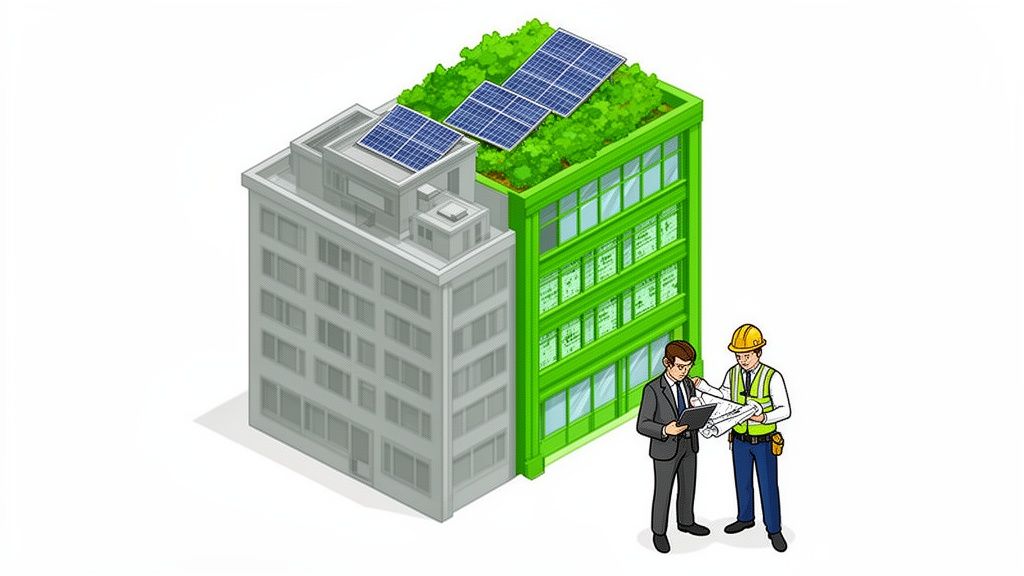
To many business owners, “going green” sounds abstract and, frankly, expensive. But when we talk about green retrofitting buildings, we’re not talking about feel-good gestures. We’re talking about a rock-solid financial strategy that boosts performance and operational efficiency.
It’s about transforming your existing commercial or industrial building from a predictable cost center into a high-performing asset.
Why Green Retrofitting Is a Smart Business Move
The core idea is simple. Instead of tearing down and building new, you upgrade your current property’s essential systems. This sidesteps the huge upfront carbon emissions and eye-watering costs that come with new construction.
In fact, we’ve seen that retrofitting can be 30% cheaper per square foot than a new green build. That’s a huge saving, and it’s possible because you’re working with the existing structure, foundation, and building envelope.
The Financial Case for Upgrading
The business argument for retrofitting is about more than just those initial savings. Think of it as a strategic investment that pays you back across multiple parts of your business.
Here’s where you’ll really see the returns:
- Slash Your Operating Costs: This is the benefit you’ll feel first. Upgrading an inefficient HVAC system, swapping out old lighting, and properly insulating the building envelope show up immediately as lower monthly energy and water bills. For most projects, these savings are the biggest chunk of the ROI.
- Boost Your Property Value: It’s simple supply and demand. Buildings with green certifications and lower running costs are magnets for tenants and buyers. A retrofitted building can command higher rents and will have a much stronger market value, protecting your asset for the long haul.
- Sharpen Your Competitive Edge: In a world where corporate responsibility actually matters, a green-certified building makes you stand out. It burnishes your brand’s image and becomes a powerful tool for attracting top talent and clients who are looking for partners that share their values.
A deep energy retrofit isn’t just about swapping out a few light bulbs. It’s a holistic overhaul of your building’s performance, creating a symbiotic relationship between systems to maximize efficiency and deliver a powerful return on investment.

Beyond the Bottom Line
While the numbers are compelling, the operational benefits are just as crucial. A well-planned retrofit has a direct, positive impact on the people who use the building every day.
For example, improving indoor air quality (IAQ) with better ventilation and modern HVAC filtration often leads to a healthier, more productive workforce. Upgrading your lighting doesn’t just cut energy use; it can genuinely improve employee comfort and focus. You can find more practical details on choosing the right fixtures in our guide to energy-saving LED bulbs.
Ultimately, green retrofitting is a forward-thinking business strategy. It’s a practical way to get ahead of rising energy costs, future-proof your assets against new climate regulations, and create a better, healthier space for everyone inside. It proves that sustainability and profitability don’t just coexist—they drive each other forward. This guide will walk you through the steps to start making these benefits a reality for your building.
Conducting a Building Performance Assessment That Works
So you’re ready to tackle a green retrofit. Before you jump into picking out new equipment or materials, the very first step—and I can’t stress this enough—is getting a clear, data-driven baseline of how your building is actually performing. Just glancing at utility bills isn’t going to give you the whole picture. A thorough building performance assessment is what separates a successful, cost-effective project from an expensive guessing game.
Think of it as a complete physical for your property. This detailed evaluation provides the hard data you need to prioritize upgrades, justify the investment, and prove your ROI down the line. It’s about seeing your building as a dynamic system, not just a static box.
The stakes are higher than you might think. The global built environment is a massive contributor to emissions, responsible for a staggering 38% of worldwide greenhouse gases. About 28% comes from just operating the buildings—heating, cooling, and lighting—while another 11% is tied to construction materials. Green retrofitting is our best tool to turn this around, slashing those emissions while making buildings last longer. It’s no surprise the energy-efficiency retrofit market is projected to grow from $500 billion in 2026 to an incredible $3.9 trillion by 2050.
What a Comprehensive Audit Looks For
A proper assessment is part detective work, part data analysis. Experienced auditors don’t just walk around and take notes; they use specialized tools to uncover the hidden problems that are quietly draining your budget.
Here are the key areas any professional audit will dig into:
- Building Envelope Integrity: This is your building’s first line of defense against energy loss. We use tools like infrared cameras to literally see where heat is escaping through poorly insulated walls, thermal bridges, and leaky windows. It’s amazing what these cameras reveal.
- Air Leakage Detection: You’d be shocked by how many tiny cracks and gaps add up to massive energy waste. Beyond a visual check, we’ll often use a blower door test to pressurize the building or a simple handheld smoke puffer to pinpoint drafts. Our guide on using a smoke puffer to identify air leaks shows just how effective this simple technique can be.
- HVAC and Mechanical Systems: We’ll scrutinize everything—boilers, chillers, air handlers, and all the ductwork. We’re looking at efficiency ratings, maintenance logs, and actual performance to see if your systems are oversized, outdated, or just plain inefficient.
- Lighting and Electrical Systems: This involves a full inventory of your lighting. We look at the type, wattage, and controls. The goal is to find opportunities for upgrading to high-efficiency LEDs and adding smart controls like occupancy sensors, which are often a quick win.

From Data to an Actionable Checklist
Once the fieldwork is done, all that data gets translated into a prioritized action list. This isn’t just a raw data dump; it’s your strategic roadmap for the entire project. Each potential upgrade is sorted by its estimated cost, how complex it is to implement, and its likely impact on energy savings.
This process makes it easy to see how upgrades translate directly to business value.
A thorough building assessment transforms abstract goals into a concrete plan. It allows you to move from “we should save energy” to “if we invest $15,000 in air sealing and attic insulation, we’ll see a payback in under three years.”
Part of this planning involves knowing when major components are due for replacement. For instance, knowing the typical shingle roof lifespan helps you sync up a necessary roof replacement with an insulation upgrade. This kind of planning maximizes your financial return and prevents costly emergency repairs down the road. Ultimately, this detailed audit becomes your playbook for making smart, profitable upgrades.
How to Prioritize Upgrades for Maximum ROI
So, you’ve done the hard part. The energy audit is complete, and you have a mountain of data sitting in front of you. The guesswork is over, but now comes the real challenge: where do you spend your money first to get the best bang for your buck on your green retrofitting buildings project?
Your audit data is the map, but a smart priority list is what turns that map into a profitable action plan. It’s all about striking the right balance. Some upgrades offer a quick payback, while others are bigger investments that unlock massive, long-term savings. For most commercial properties, a phased approach isn’t just a good idea—it’s the only way to go.
Quick Wins vs. Deep Retrofits
Not all upgrades are created equal. In my experience, it helps to break them down into two buckets: quick wins and deep retrofits. They both have a place in a smart strategy, but they do very different jobs.
- Quick Wins: These are your low-hanging fruit. Think projects with a low upfront cost and a fast payback, often under three years. They’re perfect for getting the ball rolling and showing stakeholders an immediate return on investment.
- Deep Retrofits: These are the big-ticket items—overhauling your HVAC system, upgrading the building envelope, or a full window replacement. The initial cost is higher and the payback takes longer, but this is where you’ll find the most significant, lasting energy savings and boosts to property value.
Think of it like this: quick wins are like trimming your monthly expenses, while deep retrofits are more like making a long-term, high-yield investment in your property’s future.
A Real-World Scenario: Warehouse Upgrade
Let’s put this into practice. Imagine you’re managing a 50,000-square-foot warehouse built back in the 1990s. Your energy audit flags two big problems: ancient, energy-guzzling lighting and an inefficient, aging rooftop HVAC unit that’s on its last legs.
Your quick win here is an LED lighting conversion. Tearing out old metal halide or fluorescent fixtures and replacing them with modern commercial LEDs and occupancy sensors is a no-brainer. The project is relatively straightforward, and you can see immediate energy savings of 50-70%. The payback? Usually just 1-3 years.
Your deep retrofit, on the other hand, is that full HVAC overhaul. This is a much bigger capital expense. It means new high-efficiency rooftop units, smart controls, and probably some ductwork sealing while you’re at it. The payback might stretch to 7-10 years, but the long-term energy reduction, improved tenant comfort, and drop in future repair bills will be huge.
The goal isn’t to choose one over the other. The smart move is to use the savings from your quick-win lighting project to help fund the capital for the deeper HVAC retrofit a year or two down the line.
This creates a self-funding cycle of improvements, making the whole process much more manageable.
Creating Your Cost-Benefit Framework
To make these calls with confidence, you need a simple way to weigh each potential project. I always tell clients to look at every potential upgrade through these three lenses:
- Upfront Cost vs. Payback: This is the bread and butter. Calculate the simple payback by dividing the total project cost by the estimated annual savings. It’s the metric that gets budgets approved.
- Impact on Building Operations: Look beyond the utility bill. Will this upgrade make occupants more comfortable? Boost productivity? Reduce those annoying maintenance calls? A new HVAC system, for example, does wonders for indoor air quality, which is a huge plus for tenants and employees.
- Alignment with Business Goals: Does the project help you hit specific sustainability targets or meet new compliance rules? These upgrades can be a powerful marketing tool for your corporate brand and a major draw for attracting new tenants.
When you start adding it all up, the financial case becomes crystal clear. There’s a massive opportunity to turn our aging commercial buildings into energy-saving assets. Over $279 billion in investments could be poured into these projects, unlocking more than $1 trillion in energy savings in just 10 years. That’s enough to slash about 30% of the nation’s total electricity spending. You can read more about the staggering economic potential of retrofitting on Climate-x.com.
Retrofit Project Comparison Cost vs. Impact
To help you visualize these trade-offs, here’s a quick comparison of common retrofit projects. It lays out the typical costs, payback periods, and overall impact you can expect.
| Retrofit Project | Upfront Cost | Typical Payback Period | Energy Savings Potential | Example Conservation Mart Product |
|---|---|---|---|---|
| LED Lighting Upgrade | Low | 1-3 Years | High | Commercial LED Fixtures |
| Smart Thermostats | Low | < 2 Years | Medium | Programmable & Smart Thermostats |
| Weatherization | Low-Medium | 2-5 Years | Medium | Weatherstripping |
| High-Efficiency HVAC | High | 7-15 Years | Very High | Modern HVAC Units & Controls |
| Window Replacement | Very High | 10-20+ Years | High | Energy-Efficient Windows |
| Water Fixture Upgrades | Low | 1-4 Years | Medium | Low-Flow Aerators |
As you can see, a project like installing smart thermostats is a perfect example of a low-cost upgrade that delivers on both financial and operational goals. For a closer look, you might be interested in our guide to selecting an affordable smart thermostat for your business.
By using this kind of framework, you can build a phased retrofitting plan that delivers real, measurable results at every stage, all while staying on budget and hitting your long-term goals.

Executing High-Impact Commercial Building Upgrades
Alright, the audits are done and you’ve picked your battles. Now for the fun part: turning all that analysis into actual, tangible savings. This is where your green retrofitting buildings project really gets going.
Success from here on out is all about smart execution. You need to tackle the building systems with the biggest impact without throwing a wrench into your daily operations. This isn’t about slapping on a few fixes here and there; it’s about understanding how these systems interact to create a truly efficient building.
Let’s break down where you’ll get the most bang for your buck. A big piece of the puzzle involves comprehensive energy efficiency upgrades that can slash operating costs and make your facility a much better place to be.
Sealing the Building Envelope
Think of your building’s envelope—the roof, walls, windows, and foundation—as its first line of defense. It’s the only thing separating your conditioned indoor air from the weather outside. In fact, the envelope can influence roughly 50% of a typical building’s energy demand. Every leak and uninsulated spot makes your HVAC system work harder, and that costs you money.
Start with the easy wins: air sealing. This is often a low-cost, high-impact first step.
- Weatherstripping and Caulking: Do a thorough sweep. Inspect and seal every gap around windows, doors, and where pipes or vents penetrate the walls. Make sure to use commercial-grade materials that can handle your building’s use and abuse.
- Insulation: Take a hard look at your insulation, especially in the attic or roof space. This is a notorious spot for heat to sneak in or out. Adding blown-in insulation or rigid foam board can make a world of difference in thermal resistance.
Replacing windows is a bigger spend, but the payoff can be huge, especially in older buildings. Modern double- or triple-pane windows with low-emissivity (Low-E) coatings act like a mirror for heat, keeping you cooler in the summer and warmer in the winter.
Modernizing HVAC and Mechanical Systems
Your Heating, Ventilation, and Air Conditioning (HVAC) system is almost certainly one of the biggest energy hogs in your building. Bringing this equipment into the 21st century is a non-negotiable part of any serious retrofit.
The mission is to swap out old, clunky equipment for modern, high-efficiency models. Upgrading to ENERGY STAR rated boilers, chillers, and rooftop units can cut HVAC energy use by 20% to 50%, depending on what you’re starting with.
Pro Tip: Tackle your building envelope first. A well-sealed and insulated building doesn’t need as much heating and cooling. This means you might be able to downsize your new HVAC system, saving a bundle on the equipment itself.
Beyond the big units, smart controls are where the real magic happens.
- Smart Thermostats: At a minimum, install programmable or smart thermostats that align with your actual occupancy schedules.
- Building Automation Systems (BAS): For larger buildings, a BAS is a game-changer. It can optimize your entire mechanical system, adjusting everything from ventilation to lighting based on real-time needs.
- Variable Frequency Drives (VFDs): This is a huge one. Putting VFDs on fan and pump motors lets them ramp up or down to meet demand instead of just running full-blast all the time. This move alone can deliver energy savings of 30% or more.
When you’re scheduling this work, try to replace major equipment in the spring or fall. Taking your HVAC offline is a lot less disruptive when you don’t really need it.
Upgrading Lighting and Electrical Systems
For a quick-win project with a fast payback, look no further than your lights. Switching from old fluorescent, metal halide, or high-pressure sodium fixtures to modern LEDs is one of the smartest moves you can make.
Don’t just swap bulbs—think bigger.
- LED Fixtures: Replace the whole fixture. It ensures you get the best performance and longest life. Always look for products qualified by the DLC (DesignLights Consortium) for proven quality.
- Occupancy and Vacancy Sensors: Put these everywhere they make sense: offices, conference rooms, warehouses, and restrooms. Occupancy sensors are fully automatic; vacancy sensors require a manual turn-on but shut off automatically, which is great for meeting certain energy codes.
- Daylight Harvesting: If you’ve got spaces with good natural light, use photosensors to automatically dim the electric lights when the sun is doing the work for you.
A well-planned lighting retrofit can slash lighting-related energy costs by 50% to 90% and makes the space more comfortable for everyone. Best of all, most of this work can be done after hours, so nobody even notices.
Implementing Water Conservation Measures
It’s easy to get tunnel vision on energy, but don’t forget about water. Every gallon you save is a gallon you don’t have to pay for, and it also cuts the energy used for water heating. It’s a two-for-one deal.
These upgrades are usually cheap, easy, and pay for themselves in no time.
- Low-Flow Toilets and Urinals: If you still have old high-flush toilets, replacing them with modern WaterSense models is a must. Going from a 3.5 gallons per flush (GPF) toilet to a 1.28 GPF model saves over 60% of the water with every single flush.
- Faucet Aerators: This is the easiest upgrade on the list. Screw low-flow aerators onto every sink in your restrooms and breakrooms. It’s a five-minute job that can cut water flow by 30% or more without anyone noticing a drop in pressure.
- Low-Flow Showerheads: If you have showers (think gyms, hospitals, or industrial sites), swapping out the showerheads is another no-brainer for immediate water and energy savings.
These water-saving measures are so simple and minimally disruptive, they make a perfect starting point or a great add-on to any larger retrofit project.
Verifying Your Savings and Ensuring Long-Term Success
The last contractor has packed up, the new systems are humming, and your building is finally operating with its new upgrades. It’s tempting to call the green retrofitting buildings project done. But the real moment of truth—and the most critical part for proving the project’s value—is just getting started. This is where measurement and verification (M&V) comes in.
M&V is how you turn your projected savings into cold, hard numbers. It’s about collecting the data that shows a clear return on investment to your stakeholders, transforming the project from a line-item expense into a proven financial and environmental win. Think of it less as the end of the project and more as the beginning of a cycle of continuous improvement.
Tracking Your Performance Post-Retrofit
Remember that building performance assessment you did to establish a baseline before the work began? Now’s the time to pull it out. That data is your yardstick for success. The goal is to simply compare your utility bills before and after the retrofit to see exactly how much you’re saving.
You’ll want to start gathering your utility bills for at least 12-24 months after the project is complete. A long-term view is essential here, as it helps smooth out any weird spikes and accounts for seasonal swings in energy and water use.
Here’s what you should be tracking:
- Energy Consumption: Look at your monthly kilowatt-hour (kWh) usage for electricity and therms or cubic feet for natural gas. If you installed submeters on specific systems, like the new HVAC or lighting, you can get even more granular. This lets you pinpoint which upgrades are the real workhorses.
- Water Usage: Compare your water bills to quantify the impact of those new low-flow fixtures. Whether your utility bills in gallons or cubic feet, the principle is the same.
- Weather Normalization: Let’s be honest, a mild winter can make anyone’s energy savings look good. To get a true picture, you need to account for the weather. Using heating degree days (HDD) and cooling degree days (CDD) is a straightforward way to normalize your data and ensure you’re making a fair, apples-to-apples comparison.
Your post-retrofit data is more than just a report card; it’s a powerful tool. Use it to fine-tune building controls, justify future investments, and provide concrete proof of your project’s financial success to your leadership team.
This data also builds a powerful case for upgrading existing buildings instead of just building new. It might surprise you, but landmark research shows that commercial buildings from before the 1920s, once retrofitted, often use less energy per square foot than many modern structures. Globally, this approach of reusing buildings can conserve up to 80% of embodied carbon compared to demolition and new construction. While simple lighting upgrades are a good start, it’s the deep retrofits that really move the needle for cities aiming to meet ambitious climate goals. You can explore the research on retrofitting sustainability at WBDG.org for more on these findings.
A Simple Maintenance Checklist for Peak Performance
Think of your new high-efficiency systems like a high-performance car—they need regular tune-ups to keep running at their best. Letting maintenance slide is the fastest way to watch those hard-won savings slowly disappear. A proactive maintenance schedule is your best insurance policy against performance decline.
Here’s a simple checklist to help protect your investment:
-
HVAC Systems:
- Quarterly: Inspect and replace air filters. This is non-negotiable. Dirty filters are one of the biggest culprits of lost efficiency.
- Annually: Bring in the pros for a full service. They should check refrigerant levels, clean coils, and inspect belts and motors.
-
Building Envelope:
- Semi-Annually: Do a walk-around and visually inspect window seals, door weatherstripping, and any exterior caulking. Look for cracking or peeling and re-seal any gaps you find before they become bigger problems.
-
Lighting Systems:
- Quarterly: Give fixtures and lenses a good cleaning. You’d be surprised how much light output is lost to dust buildup—sometimes 10% or more.
- As Needed: Don’t let a burnt-out lamp or a failed ballast linger. Replace them promptly.
-
Water Fixtures:
- Annually: Check faucet aerators and showerheads for mineral buildup, which can mess with flow and pressure. A simple soak in vinegar is usually enough to clear them out.
By making M&V and a simple maintenance routine part of your standard operations, you ensure your green retrofit delivers on its promise for years to come. You’re not just protecting an investment; you’re building a culture of continuous improvement that keeps your building operating at peak efficiency.
Common Questions About Commercial Green Retrofits
Even with the best plan in hand, diving into a commercial retrofit project can bring up a lot of questions. It’s only natural. We hear from facility managers and business owners all the time, and many of them have the same core concerns about cost, operational headaches, and the real-world value of the investment.
Let’s tackle some of the most common questions we hear about green retrofitting buildings, with practical answers that get straight to the point.
What’s a Green Retrofit Going to Cost Me?
This is the big one, and the honest answer is: it really depends. The final price tag hinges on your building’s size, its current condition, and just how deep you’re willing to go with the upgrades.
For example, a “shallow” retrofit focusing on the quick wins—like swapping all your lights for high-efficiency LEDs and installing low-flow water fixtures—might only run you a few thousand dollars. The beauty of these projects is their fast payback, often in just 1-3 years.
A “deep” retrofit, on the other hand, is a more serious capital investment. We’re talking about major system overhauls—a new high-efficiency HVAC system, new windows, or a complete building envelope upgrade with better insulation. While the upfront cost is higher, this is the path to the biggest long-term energy savings and a significant boost in property value.
The best first step is always a professional energy audit to figure out the most cost-effective approach for your specific building.
Can Our Business Stay Open During a Retrofit?
Absolutely. A huge part of any professional project is smart phasing to keep disruptions to a minimum. Experienced contractors are experts at working around your schedule.
Many upgrades can be handled during off-hours, on weekends, or by tackling one section of the building at a time.
- Lighting upgrades are a perfect example. They’re quick and can easily be done after everyone has gone home for the day.
- Installing low-flow faucet aerators or other water-saving devices creates almost zero interruption.
More complex jobs, like an HVAC replacement, do require careful coordination. But a well-planned project schedule ensures your business can keep running smoothly while the work gets done.
What’s the Difference Between Retrofitting and Renovating?
People often use these terms interchangeably, but they have very different meanings in our world. “Renovating” is usually about aesthetics or function—things like changing an office layout or giving the lobby a modern facelift. It’s all about improving the look and feel.
“Green retrofitting,” on the other hand, is laser-focused on upgrading a building’s core performance systems—specifically its HVAC, lighting, insulation, and water fixtures—to improve energy efficiency and slash operational costs.
The main goal of a retrofit is to cut your utility bills and shrink your carbon footprint. Happily, much-improved occupant comfort and a healthier indoor environment are fantastic side effects of the process.
Are There Tax Credits for Green Retrofitting Buildings?
Yes, and you should definitely take advantage of them. There are a number of powerful federal, state, and local incentives for commercial energy efficiency projects. These come in the form of tax credits, direct rebates, and even grants.
The Inflation Reduction Act of 2022, for instance, gave a significant boost to the 179D Commercial Buildings Energy-Efficiency Tax Deduction. It’s also smart to check with your local utility provider. Many offer their own rebate programs for specific upgrades like new lighting or HVAC systems. To make sure you get every dollar you’re entitled to, consulting with a tax professional who knows these programs inside and out is a must.