

What if you could slash a major operating expense by up to 90% with one simple, targeted upgrade? It’s not just a nice thought—it’s what happens every day when businesses make the switch to energy saving LED bulbs. These aren’t just light bulbs; they’re smart assets that deliver real financial and operational wins.
Why LED Bulbs Are A Strategic Business Upgrade
For most facility managers, property owners, and financial officers, lighting shows up on the books as a fixed, unavoidable cost. But looking at it through the lens of LED technology completely flips that script. Suddenly, that line item becomes a strategic opportunity for massive savings and facility-wide improvements.
This isn’t just about swapping out old bulbs. It’s a fundamental upgrade to your building’s infrastructure.
Old-school lighting, like incandescent or fluorescent bulbs, are notorious energy hogs, wasting a huge chunk of electricity as heat. In stark contrast, energy saving LED bulbs are incredibly efficient, converting nearly all their energy directly into light. This efficiency immediately shows up on your utility bills, often cutting lighting-related energy use by 75% or more.
More Than Just Energy Savings
The financial perks go way beyond just a lower power bill. You have to look at the total cost of ownership, which is where things get really interesting.
- Maintenance Costs Plummet: LEDs last an incredibly long time. A commercial-grade LED can run for 25,000 to 50,000 hours. Compare that to an old incandescent bulb that might last just 1,000-2,000 hours. This longevity means far fewer replacements, which cuts down on labor costs and the hassle of disrupting operations to change a light.
- A Better Place to Work: Modern LEDs produce a much higher quality of light, which makes a big difference in creating a better environment for both employees and customers. In an office, that can mean better focus and productivity. In a retail store, it means products look their best.
- Hit Your Green Goals: Making the switch to LEDs is a tangible, highly visible way to meet corporate sustainability targets. It’s a clear signal that your company is committed to environmental responsibility, which can boost your brand’s reputation and help you meet regulatory standards.
When you start treating an LED retrofit as a capital investment instead of a maintenance chore, you unlock serious long-term financial returns. You have to consider the whole package: the energy savings, the drastically lower maintenance, and the potential boosts in productivity.
When you’re building the case for a strategic LED upgrade, be sure to look into incentive programs. They can dramatically lower your upfront investment and supercharge your ROI. For instance, you can unlock energy savings through programs like the Enbridge Gas Direct Install Program which helps businesses get these kinds of efficiency projects off the ground. Many utilities offer similar rebates specifically for commercial lighting, making the financial decision to switch even easier.
Decoding LED Specs for Your Commercial Space
When you’re outfitting a commercial facility, grabbing the right energy saving LED bulbs is about much more than just matching an old bulb’s wattage. Those technical specs on the side of the box? They’re not just jargon. They’re critical data points that directly impact your operational efficiency, your team’s productivity, and—ultimately—your bottom line. You need to translate those numbers into practical business intelligence.
The most common mistake we see is people focusing on watts to figure out brightness. In the world of LEDs, that’s history. Watts measure energy consumption, not light output. The number you really need to care about is lumens (lm), which tells you the actual amount of visible light the bulb produces. Think of it as the true measure of brightness.
The Real Measure of Efficiency: Luminous Efficacy
To really get a feel for a bulb’s performance, you need to look at its luminous efficacy, measured in lumens per watt (lm/W). This metric is the lighting equivalent of a car’s miles per gallon (MPG). It tells you exactly how efficiently a bulb turns electricity into light—the higher the number, the more light you get for every single watt you pay for.
It’s a huge difference. A traditional incandescent bulb might struggle to hit an efficacy of 15 lm/W. A modern commercial LED? It can easily top 100 lm/W. This is where the eye-popping energy savings really come from.
For facility managers, a higher luminous efficacy means you can hit the brightness levels you need in a warehouse or office while slashing your power usage. This translates directly into lower utility bills without ever compromising on safety or visibility.
The flowchart below breaks down the core benefits of making the switch. It’s a clear line from reduced energy and maintenance to a much stronger financial and sustainable footprint for your business.
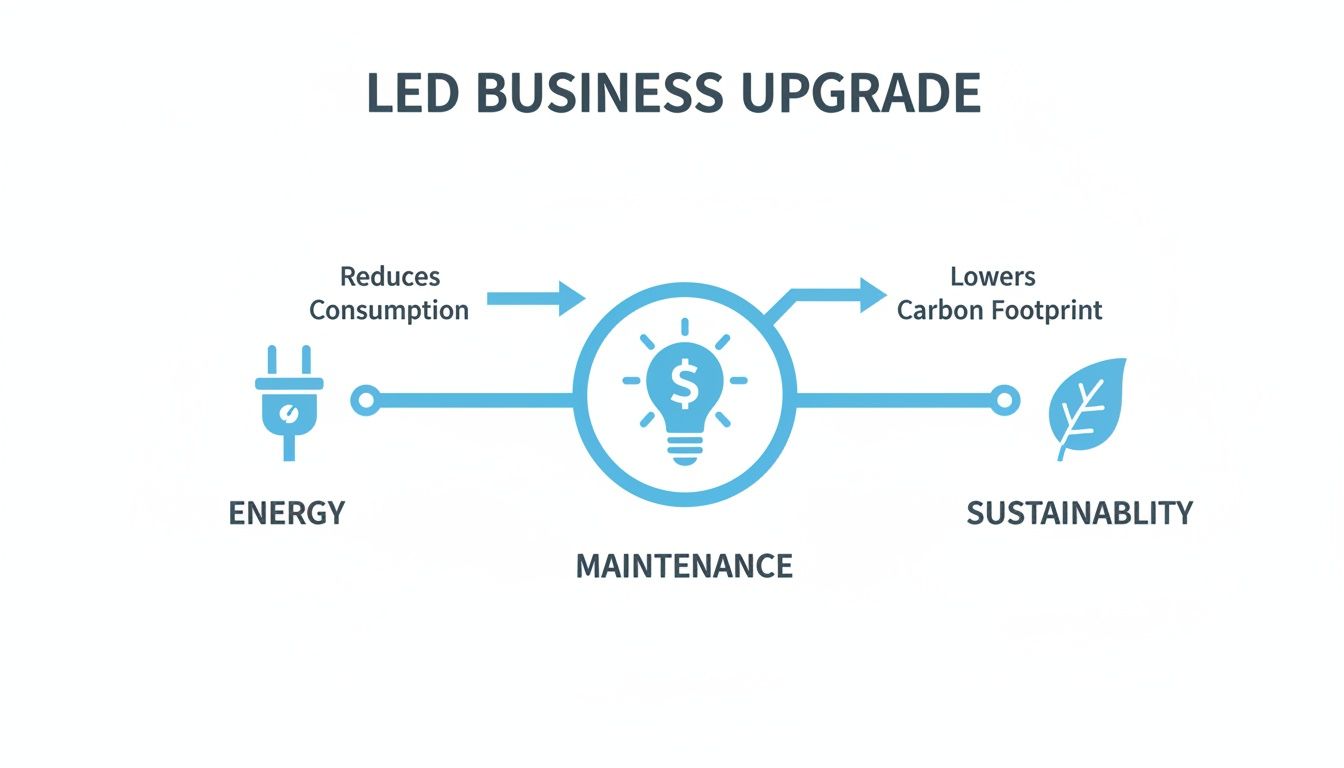
As you can see, it creates a positive feedback loop. Lower energy use and less time spent on maintenance directly boost your financial performance and your company’s sustainability credentials.
How Light Quality Affects Your Business Operations
It’s not all about brightness and efficiency, though. The quality of the light itself plays a massive role in any commercial space. Two key metrics—Color Rendering Index (CRI) and Correlated Color Temperature (CCT)—determine how colors look under the light and the overall “feel” of a room.
- Color Rendering Index (CRI): This is a simple 0-to-100 scale measuring how accurately a light source shows the true colors of objects. If you’re running a retail store or a design firm, a high CRI (90+) is non-negotiable. Poor color rendering can make fresh produce look lifeless or fabric colors appear totally wrong, which can tank sales.
- Correlated Color Temperature (CCT): Measured in Kelvin (K), CCT describes the light’s color appearance, from warm to cool. Lower CCTs (2700K-3000K) give off a warm, yellowish light perfect for hospitality settings. Higher CCTs (4000K-5000K) produce a cool, bluish-white light that mimics daylight and can even boost focus, making it a great choice for offices and manufacturing floors.
Get the CCT wrong, and you can negatively impact mood and productivity. Get it right, and you create the perfect environment for your specific operations.
Key LED Metrics for Commercial Procurement
To help you keep these critical specs straight, here’s a quick reference table. Think of it as a cheat sheet for making sure you’re asking the right questions and getting the right bulbs for the job.
| Metric | What It Measures | Why It Matters for Your Business | Ideal Range for Commercial Spaces |
|---|---|---|---|
| Lumens (lm) | Total light output (brightness) | Ensures spaces are lit to required safety and productivity standards. | Varies by space; based on foot-candle requirements. |
| Luminous Efficacy (lm/W) | Efficiency (light per watt) | Directly impacts energy costs; higher efficacy means greater savings. | 100 lm/W or higher |
| Color Rendering Index (CRI) | Color accuracy (0-100) | Crucial for retail, design, and healthcare where true colors are essential. | 80+ for general use; 90+ for color-critical tasks. |
| Correlated Color Temp. (CCT) | Light color (warm to cool) | Affects mood, alertness, and the aesthetic of the space. | 3000K-4000K for general office/retail; 5000K+ for tasks. |
This table should give you a solid framework for evaluating any LED product against the real-world needs of your facility. It’s all about matching the bulb’s performance to the demands of the space.
Understanding Light Distribution and Directionality
Finally, you have to consider how a bulb actually spreads its light. Unlike old incandescents that threw light in every direction (including up into the fixture where it was wasted), LEDs are naturally directional. This is a massive plus for things like spotlights and downlights, where you want a focused beam of illumination without any waste.
But what about general lighting in lamps or overhead fixtures? You need broader coverage there. That’s where different bulb designs come in. To get the full picture on how bulb shape affects light spread, check out our guide on what an omni-directional LED bulb is and how it delivers that classic 360-degree illumination.
Matching the bulb’s light distribution to the fixture and the task is key. It ensures you aren’t paying to light up the ceiling when you really need that light down on the work surfaces below.
Understanding Critical LED Ratings and Certifications
Okay, we’ve talked about the performance specs like lumens and CCT. Now, let’s get into the alphabet soup of logos you’ll see on a spec sheet. These aren’t just for decoration; they’re your guarantee of safety, performance, and—most importantly—your ticket to getting some serious money back.
For any facility manager looking at a large-scale purchase of energy saving LED bulbs, skipping over these details is a costly mistake.
Putting the wrong bulb in the wrong place can cause it to fail way too early, and in some cases, it’s an outright safety hazard. This is especially true when moisture gets involved, which is why location ratings should be one of the first things you check.
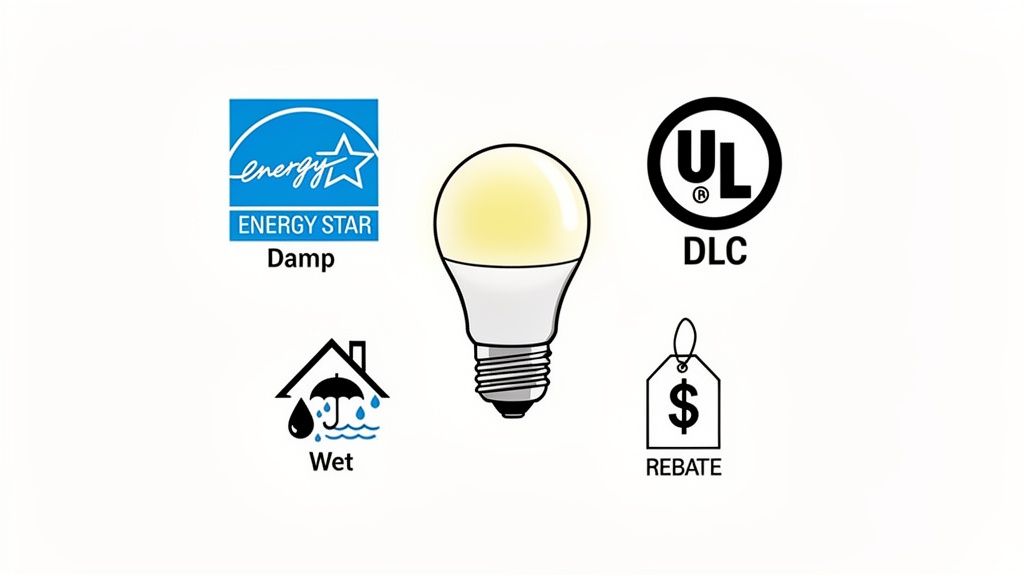
Damp Rated vs. Wet Rated Environments
Let’s be real—not every corner of a commercial building is bone-dry. Think about covered loading docks, some commercial kitchens, or utility closets. These areas are prone to humidity and condensation. For spots like these, you need a Damp Rated LED bulb. They’re built to handle moisture in the air, but they aren’t designed to get hit directly with rain or a spray from a hose.
When you move to exterior lighting, car washes, or any area that gets washed down, you absolutely have to level up to a Wet Rated LED. These products are completely sealed to keep water from ever touching the electronics inside. They’ll keep running reliably even when the weather gets nasty. For a deeper dive, check out our guide comparing damp vs wet rated LED bulbs.
Choosing the wrong rating isn’t just a warranty issue; it’s a genuine safety risk. Matching the bulb to its environment is non-negotiable for a successful lighting project.
The Key to Unlocking Rebates
While location ratings are about durability, other certifications are all about the money. If you’re planning a commercial LED retrofit, there are two logos you simply cannot ignore: ENERGY STAR and DesignLights Consortium (DLC).
- ENERGY STAR: You’ve probably seen this government-backed symbol on appliances. For lighting, it means the product has passed tough standards for both efficiency and lifespan. It’s a mark of quality.
- DesignLights Consortium (DLC): The DLC is the big one for commercial lighting. Their Qualified Products List (QPL) is essentially the bible for utility companies that offer rebates. If a product is on the DLC list, it’s been vetted for high performance.
For any business, these certifications are the gatekeepers to utility rebate programs. Seriously. Buying a DLC-listed product can knock 30-50% off the upfront project cost, slashing your payback period and making the whole upgrade a much smarter investment.
Finally, always look for safety certifications. You can get a better handle on what these mean by understanding UL certifications, which confirm that a product has been independently tested to meet established safety standards. These logos protect your property, your people, and your investment.
How to Plan Your Commercial Led Retrofit
A successful switch to energy saving led bulbs isn’t something that just happens. It’s the result of a smart, well-thought-out plan. For any facility manager, a strategic lighting retrofit is a high-impact project that can turn a major operational expense into a serious source of savings. This framework will walk you through the entire process, from the first walk-through to building a business case that gets the green light from management.
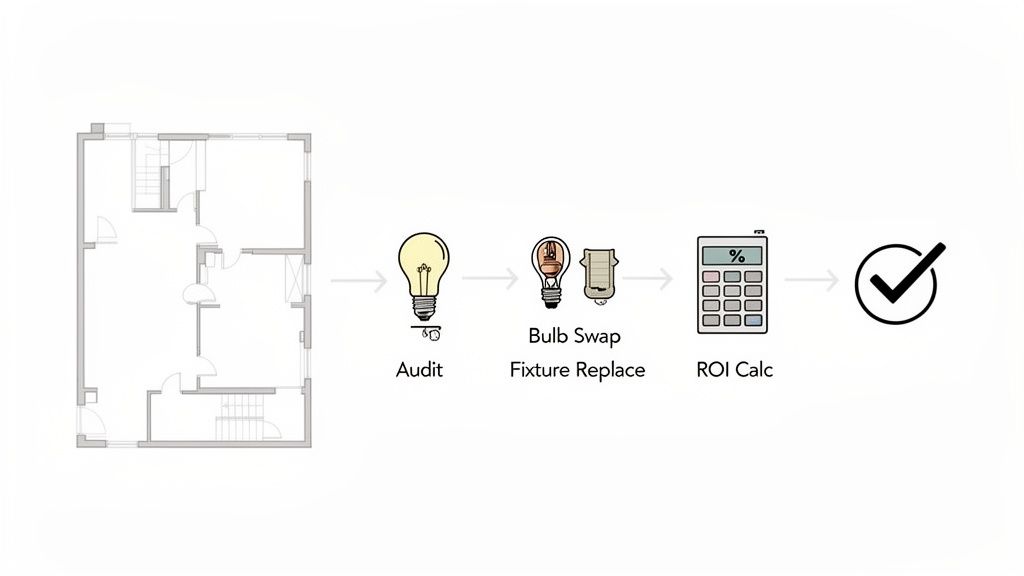
It all starts with a comprehensive lighting audit. You can’t chart a course to a better, more efficient future until you know exactly where you stand right now. Think of the audit as your fact-finding mission.
Conduct a Thorough Lighting Audit
Before you can even begin to estimate potential savings, you need a precise inventory of what you’re currently running. Walk through your entire facility—every office, warehouse bay, hallway, and parking area—and get a clear picture of your existing lighting system.
During your audit, you’ll want to capture a few key data points for each space:
- Fixture and Bulb Type: What are you working with? Are they T8 fluorescent tubes, big metal halide high bays, or screw-in compact fluorescents (CFLs)? Note the type, size, and exact quantity.
- Wattage per Bulb: This is critical. Record the wattage of every bulb currently in use. This number is the foundation for all your energy calculations down the line.
- Operating Hours: Think about how long the lights are on. A warehouse light that runs 24/7 has a completely different energy footprint than a conference room light that’s only used five hours a week. Get a solid estimate for each area.
- Light Levels and Quality: Take a step back and assess the light itself. Is it doing its job? You might find some areas are overlit, while others are too dim for safe and productive work.
This audit gives you a detailed map of your current energy consumption. More importantly, it highlights the most inefficient, high-cost areas that are ripe for an upgrade.
Choose Your Retrofit Strategy
With your audit data in hand, it’s time to decide on the best approach for your facility. Commercial LED retrofits typically fall into one of three buckets, each with its own balance of cost, complexity, and long-term payoff.
- Simple Bulb Swap (LED Replacement Lamps): This is the most straightforward route. You’re simply replacing an old bulb—like a fluorescent tube or CFL—with an LED version designed to pop right into the same fixture. It has the lowest upfront cost and causes minimal disruption.
- Retrofit Kits: This option is a step up. It involves modifying the existing fixture by replacing its guts (like the old ballast) with new LED drivers and light engines. You get better performance and efficiency than a simple swap without having to buy a whole new fixture.
- Full Fixture Replacement: This is the most comprehensive strategy. You remove the old fixture entirely and install a brand-new, purpose-built LED luminaire. While it’s the biggest initial investment, it delivers the absolute maximum energy savings, superior light quality, and the longest lifespan.
The right strategy really depends on your budget and the condition of your existing fixtures. If you’re dealing with aging or incompatible fixtures, a full replacement often provides the best long-term return on investment, saving you from future maintenance headaches.
For many businesses, getting rid of old linear fluorescent fixtures is priority number one. Our guide to replacing fluorescents with T8 LED light bulbs breaks down the specific steps and things to watch out for in this very common—and highly effective—upgrade.
Calculate Your Projected ROI
Once you’ve picked a strategy, it’s time to build the business case with a clear Return on Investment (ROI) calculation. This is where you turn your audit data into a powerful financial argument that executives can easily understand and get behind.
Let’s walk through a simple example.
Step 1: Calculate Annual Energy Savings
First, figure out the wattage reduction for each new fixture. Then, you’ll multiply that by the operating hours and your electricity rate. Let’s say a warehouse is replacing 250-watt metal halides with new 95-watt LED high bays:
- Wattage Savings: 250W – 95W = 155 Watts
- Convert to Kilowatts: 155W / 1000 = 0.155 kW
Step 2: Apply Operating Hours and Cost
Now, let’s assume the lights run 12 hours a day, 365 days a year, and the electricity rate is $0.12 per kWh:
- Annual Hours: 12 hours/day * 365 days = 4,380 hours
- Annual kWh Savings per Fixture: 0.155 kW * 4,380 hours = 678.9 kWh
- Annual Cost Savings per Fixture: 678.9 kWh * $0.12/kWh = $81.47
If that facility has 100 of these fixtures, the annual energy savings alone would be $8,147. That number is the core of your proposal. When you add in the reduced maintenance costs and any potential utility rebates, you can clearly show just how quickly the project will pay for itself.
Here’s how the numbers for a small office retrofit might look, laid out clearly.
Energy and Cost Savings Calculation Example (Office Retrofit)
| Metric | Old Fluorescent System (100 Fixtures) | New LED System (100 Fixtures) | Savings |
|---|---|---|---|
| Watts per Fixture | 64W (2x 32W T8) | 28W (2x 14W LED) | 36W per fixture |
| Total System Wattage | 6,400W (6.4 kW) | 2,800W (2.8 kW) | 3,600W (3.6 kW) |
| Annual Operating Hours | 2,600 hours (10 hrs/day, 5 days/wk) | 2,600 hours | – |
| Annual Energy Use (kWh) | 16,640 kWh | 7,280 kWh | 9,360 kWh |
| Annual Energy Cost (@$0.15/kWh) | $2,496 | $1,092 | $1,404 |
As you can see, even a straightforward upgrade in a standard office setting results in over 55% in electricity savings year after year. Combined with lower maintenance costs (no more replacing ballasts and tubes), the financial argument for making the switch becomes undeniable.
Avoiding Common Mistakes in a LED Upgrade
A commercial LED retrofit is a big investment in your building’s future. The last thing you want is for a few simple, avoidable mistakes to mess up your return. Think of this as your pre-flight checklist for a successful project that actually delivers on its promises.
One of the most frequent—and frustrating—issues we see is incompatibility. You just can’t assume that new energy saving led bulbs will play nice with your building’s existing gear, especially when you’re dealing with older control systems.
Ensuring System and Control Compatibility
A classic point of failure is the mismatch between new LED bulbs and old-school dimming systems. Those legacy dimmers were built for the high-wattage loads of incandescent bulbs. When you pair them with modern, low-wattage LEDs, you often get a recipe for flickering, buzzing, or bulbs that burn out way too soon.
Before you even think about a full-scale rollout, you absolutely have to test a sample of your chosen LEDs on your existing circuits. This one small step can save you from the massive headache and expense of discovering a major compatibility problem after everything is already installed.
It’s just common sense, really. You wouldn’t install new software on every computer in the company without testing it on a few machines first. Apply that same logic to your lighting to make sure everything works together seamlessly.
The Hidden Costs of Uncertified Bulbs
When you’re trying to keep upfront costs down, it’s tempting to grab those cheaper, uncertified bulbs from manufacturers you’ve never heard of. This is almost always a mistake that costs you more in the long run. These products are cheap for a reason—they cut corners on quality control, leading to a bunch of problems that wipe out any initial savings.
- Inconsistent Color and Brightness: Uncertified bulbs are notorious for poor color consistency. You might get one batch that’s a crisp, cool white and the next is noticeably yellow. Suddenly, your office or retail space looks patchy and unprofessional.
- Premature Burnout: That promised 25,000-hour lifespan doesn’t mean much if the internal parts, like the driver, are junk. Early failures mean more maintenance calls, which drives up your labor costs and kills the whole low-maintenance advantage of LEDs.
- Safety Risks: Without certifications like UL or ETL, you have no proof the product has been tested for electrical safety. This could expose your facility to fire hazards and might even violate building codes or your insurance policy.
To protect your investment, always stick with products from reputable brands that are listed on ConservationMart.com and carry the right safety and performance certifications.
Looking Beyond Upfront Price to Total Cost of Ownership
Focusing only on the initial price tag is probably the biggest financial trap you can fall into with a lighting upgrade. A truly smart decision is based on the Total Cost of Ownership (TCO), which gives you the full story of your investment over its entire life.
TCO looks at a few key things beyond just the per-bulb price:
- Energy Consumption: A bulb that’s a little more expensive but has a higher efficacy (more lumens per watt) will rack up greater energy savings every single year. It will quickly pay for its higher initial cost and then some.
- Maintenance and Replacement Costs: A high-quality, long-lasting bulb means you won’t be paying for labor and new bulbs to replace cheap, unreliable ones for years to come.
- Rebate Eligibility: Premium, certified products are often the only ones that qualify for those juicy utility rebates, which can knock 30-50% or more off the net cost of your project.
When you evaluate the TCO, you change the question from “How much does this cost me today?” to “What’s the best long-term financial move for my business?” That’s how you make sure your LED upgrade delivers the biggest possible return on investment.
Questions from Business Owners, Answered
Making the switch to energy saving led bulbs across an entire facility is a big decision. We get it. Facility managers, business owners, and procurement specialists always have smart questions about the money, the logistics, and the tech involved in a commercial lighting project.
This section tackles the most common questions we hear, giving you straight, clear answers to help you move forward with confidence.
What’s the Real ROI on a Commercial LED Retrofit?
This is almost always the first question, and for good reason—it’s all about the bottom line. While the exact return on investment (ROI) will depend on your building’s operating hours, your local electricity rates, and the project’s upfront cost, the numbers are almost always impressive.
Most businesses see a full payback on their LED lighting investment within 1 to 3 years. That’s fast. The return is driven by two powerful factors: a huge, immediate drop in your energy bill and the near-total elimination of maintenance costs, since these bulbs last for years and years.
On top of that, most utility companies offer some hefty rebates for commercial lighting upgrades. These incentives can slash the payback period, often bringing it under 12 months and making the financial case for switching a no-brainer.
How Do I Know If My Business Can Get LED Rebates?
The good news is, you probably can. The vast majority of utility providers run commercial lighting rebate programs to encourage businesses like yours to go energy-efficient. Getting that money is usually pretty straightforward, but it all comes down to the products you choose.
To qualify, the bulbs and fixtures you buy almost always need to be certified by one of two key organizations:
- ENERGY STAR: You’ve probably seen this government-backed blue label before. It’s a trusted mark of energy efficiency and quality.
- DesignLights Consortium (DLC): For commercial lighting, this is the big one. The DLC maintains a Qualified Products List (QPL) that’s the gold standard for performance. If a utility offers a commercial rebate, they’ll almost certainly require the products to be on the DLC list.
We always tell our clients to check their local utility provider’s website for the specifics on their commercial and industrial lighting programs. The team here at Conservation Mart lives and breathes this stuff, so we can also point you to the right rebate-eligible products for your job.
Key Takeaway: Before you place a large order for lighting, always confirm that the products are eligible for your local rebates. A five-minute check can save your company thousands and make your project’s ROI look even better.
What Do We Do with All Our Old Fluorescent and HID Bulbs?
This is a critical step that’s easy to overlook when you’re focused on the new install. Unlike modern energy saving led bulbs, old tech like fluorescent tubes, CFLs, and high-intensity discharge (HID) lamps contain mercury.
Because of that mercury, these lamps are considered hazardous waste. You cannot legally or safely toss them in a regular dumpster. Doing so can lead to stiff fines for your business and serious environmental contamination.
To do it right and stay compliant, you’ll need to use a certified recycling service that knows how to handle mercury-containing materials. Most national and local waste management companies offer commercial recycling programs specifically for this. Planning for proper disposal from day one ensures your upgrade is not just energy-efficient but also environmentally responsible.
Will New LEDs Actually Work with Our Old Dimmers and Controls?
Great question. It’s a common worry, and for good reason. While many LED bulbs are designed to be “plug-and-play,” you can run into hiccups, especially with older or more sophisticated control systems like building-wide dimmers or occupancy sensors.
The most frequent troublemaker? Old-school dimmers. Dimmers built for power-hungry incandescent or halogen bulbs often get confused by the tiny amount of energy LEDs draw. This mismatch can cause flickering, buzzing, or a dimming range that just doesn’t work right.
To avoid a building full of headaches, follow these simple steps:
- Read the Specs: Always check the technical spec sheet for the LED product. It should tell you if it’s compatible with your type of control system.
- Run a Test: This is the most important step. Before buying thousands of bulbs, buy a handful and test them in a few different spots around your facility. It’s the only way to know for sure that they’ll play nice with your existing setup.
- Talk to an Expert: For big or complex buildings, it’s smart to get a lighting specialist involved. They can look at your current system and recommend products that are guaranteed to work smoothly.
Taking these precautions helps you avoid the costly mistake of being stuck with thousands of bulbs you can’t use. Your lighting should make your job easier, not create a new maintenance nightmare.
Ready to start planning your upgrade to high-efficiency commercial lighting? The experts at Conservation Mart can help you navigate product selection, rebate qualifications, and retrofit planning to ensure your project is a financial and operational success. Explore our extensive catalog of commercial-grade energy saving led bulbs on ConservationMart.com to find the perfect solutions for your facility.